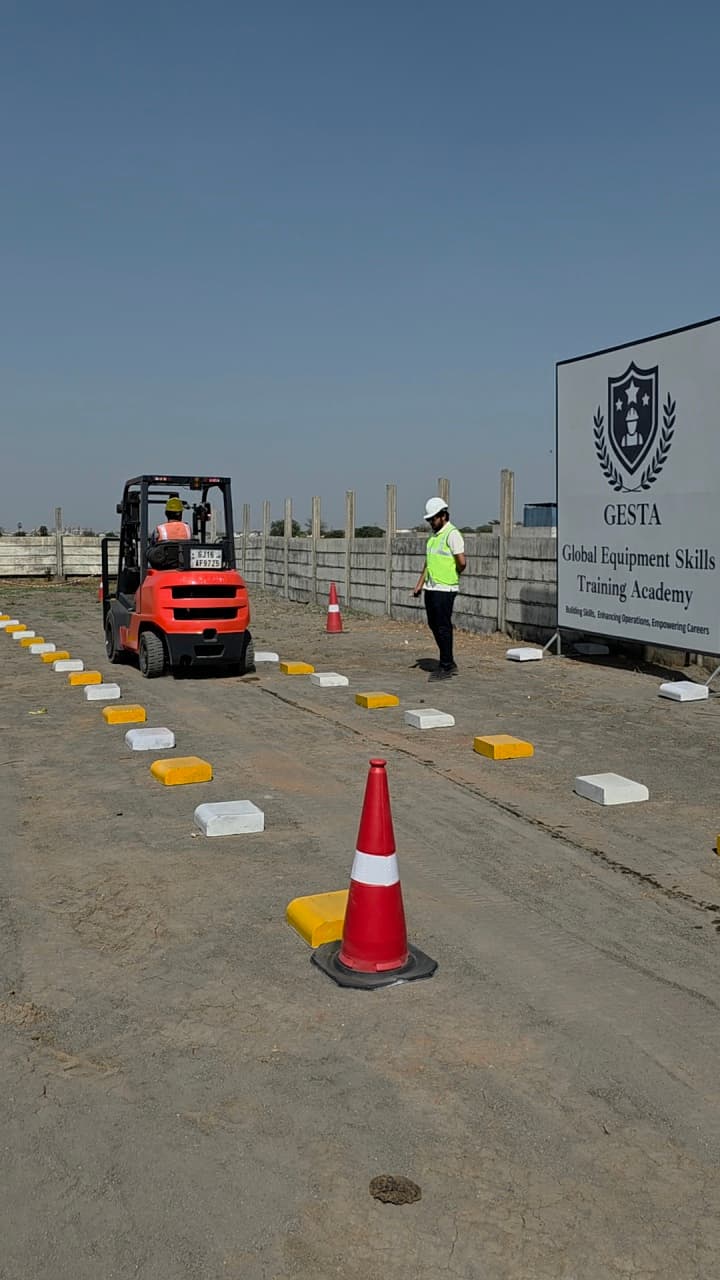
Forklift Operator Competency Training and Certification
Advanced operator development program designed for existing forklift operators to improve safety awareness, operational efficiency, load handling skills, equipment inspection practices, and compliance with industrial safety requirements through classroom instruction and extensive practical exercises.
Course Objectives
- Reinforce understanding of load center and stability principles
- Enhance maneuvering skills in confined spaces
- Improve stacking and de-stacking techniques
- Conduct effective pre-operational inspections
- Reduce equipment damage and near-miss incidents
- Improve hazard identification and risk assessment skills
- Develop safe battery charging and refueling practices
- Improve workplace traffic management awareness
- Meet company and regulatory training requirements
Standards & Worldwide Alignment
This course is assessed to GESTA-STD-001 v1.1 — GESTA's harmonised operator-competency standard benchmarked to OSHA 29 CFR 1910.178 · ISO 3691 · ANSI B56.1. A GESTA certificate demonstrates the operator competency that discharges the employer's legal duty across 46 jurisdictions worldwide.
46
Countries aligned (verified)
46
Clause-level mapped
45
Competency clauses
Course syllabus — aligned to GESTA-STD-001 v1.1
Every module maps clause-by-clause to the GESTA competency standard, harmonised from the leading national frameworks.
- 1G1
Scope & Application
Applies to all rider- and pedestrian-operated powered industrial trucks (counterbalance, reach, order-picker, pallet, rough-terrain). Excludes earth-moving and on-road haulage vehicles.
- 2G2
OPERATOR ELIGIBILITY
- G2.1Minimum age · OSHA 1910.178(l); AU/UAE
- G2.2Medical & physical fitness · ZA DMR reg 18; IN medical; L117
- G2.3Comprehension · OSHA 1910.178(l)(3)(i); PUWER reg 8
- G2.4Capacity/type legal triggers · ISH Law Art 59; WHS Reg / AS 2359; Construction Machinery Mgmt Act; NR-11 / Res. SRT 960/2015
- 3G3
TRAINER & ASSESSOR
- G3.1Trainer competency · OSHA 1910.178(l)(2)(iii); L117
- G3.2Assessor independence · OSHA 1910.178(l)(6); CSA B335
- 4G4
FORMAL (THEORY) INSTRUCTION
- G4.1Operating instructions, warnings, precautions · OSHA 1910.178(l)(3)(i)(A)/(M)
- G4.2Controls & instrumentation · OSHA 1910.178(l)(3)(i)(B)/(C)
- G4.3Engine / motor operation · OSHA 1910.178(l)(3)(i)(D)
- G4.4Steering & manoeuvring · OSHA 1910.178(l)(3)(i)(E)
- G4.5Visibility & load restrictions · OSHA 1910.178(l)(3)(i)(F)
- G4.6Forks & attachments · OSHA 1910.178(l)(3)(i)(G); ISO 5057
- G4.7Rated capacity & load charts · OSHA 1910.178(l)(3)(i)(H)
- G4.8Stability (stability triangle) · OSHA 1910.178(l)(3)(i)(I); PUWER reg 20
- G4.9Operator inspection & maintenance · OSHA 1910.178(l)(3)(i)(J); PUWER reg 6
- G4.10Refuelling / battery charging · OSHA 1910.178(l)(3)(i)(K)
- G4.11Operating limitations · OSHA 1910.178(l)(3)(i)(L)
- 5G5
Practical (hands-on) training
Trainer demonstrations plus supervised practice on the actual class of truck; min. supervised practice (e.g. CSA ≥8 hrs).
- 6G6
WORKPLACE-SPECIFIC FAMILIARISATION
- G6.1Surface & ground conditions · OSHA 1910.178(l)(3)(ii)(A)
- G6.2Load composition & stability · OSHA 1910.178(l)(3)(ii)(B)
- G6.3Stacking / unstacking · OSHA 1910.178(l)(3)(ii)(C)
- G6.4Pedestrian traffic · OSHA 1910.178(l)(3)(ii)(D)
- G6.5Narrow aisles / restricted areas · OSHA 1910.178(l)(3)(ii)(E)
- G6.6Hazardous / classified locations · OSHA 1910.178(l)(3)(ii)(F)
- G6.7Ramps & gradients · OSHA 1910.178(l)(3)(ii)(G)
- G6.8Ventilation (CO / exhaust) · OSHA 1910.178(l)(3)(ii)(H)
- 7G7
ASSESSMENT
- G7.1Theory knowledge test · OSHA 1910.178(l)(2)(ii); CSA B335
- G7.2Practical skills evaluation · OSHA 1910.178(l)(2)(ii); AU HRWL
- G7.3Workplace performance evaluation · OSHA 1910.178(l)(1)(i)
- 8G8
CERTIFICATION & RECORDS
- G8.1Written certification · OSHA 1910.178(l)(6)
- G8.2Record retention · OSHA 1910.178(l)(6); PUWER reg 8
- G8.3Scope of authorisation · OSHA 1910.178(l)(1); AU Sch 3
- 9G9
REVALIDATION
- G9.1Periodic re-evaluation · OSHA 1910.178(l)(4)(iii)
- G9.2Trigger-based refresher · OSHA 1910.178(l)(4)(ii)
- 10G10
EQUIPMENT INTEGRITY
- G10.1Pre-use inspection · PUWER reg 6; OSHA 1910.178(q)(7)
- G10.2Thorough examination · LOLER 1998 reg 9
- G10.3Planned maintenance · PUWER reg 5; OSHA 1910.178(q)
- 11G11
SAFE OPERATION
- G11.1Safe operating rules · OSHA 1910.178(m)/(n); ISO 3691-1
- G11.2Load-handling limits · OSHA 1910.178(o); L117
- G11.3Parking & shutdown · OSHA 1910.178(m)(5)
- G11.4Personal protective equipment · OSHA 1910.132; EU Directive 2009/104/EC; national OSH acts
- 12G12
GOVERNANCE
- G12.1Employer duty · OSHA 1910.178(l)(1); HSWA s2
- G12.2Road-use licensing · IN MVA 1988 s3/s39; NZ F-endorse
- G12.3Risk assessment / safe system · PUWER reg 4; EU Dir Art 3
Recognised legal frameworks by country
GESTA-STD-001 v1.1 · effective 18/7/2026 · Verified/Indicative classifications are point-in-time; verify against the current official text before formal reliance.
Syllabus & Modules
GESTA-SYL-001 · Ed. 1.0- 1
Legal framework, duties and consequences
· 1.5 hoursEnsure the operator understands the legal duties that apply to forklift operation and the consequences of non-compliance.
- Explain that only a trained, assessed and competent person may operate a forklift.
- State the employer's and the operator's respective legal duties.
- Describe how the applicable national law requires training, certification and revalidation.
- Explain the difference between the competency model and the statutory-licence model, and which applies on their site.
- 2
Forklift types, classes and major components
· 1.5 hoursEnable the operator to identify truck types/classes and their major components and understand how each affects safe use.
- Identify the main forklift types (counterbalance, reach, order-picker, pallet, rough-terrain) and OSHA/ISO classes.
- Name the major components and describe their function.
- Explain how truck type determines the hazards and the certification scope.
- 3
Controls, instrumentation and pre-start
· 1.0 hourEnsure the operator can locate, identify and correctly use every control and instrument before moving the truck.
- Locate and describe the function of all controls and instruments.
- Explain the differences between operating a forklift and driving a road vehicle.
- Carry out a correct pre-start and safe mounting/start sequence.
- 4
Pre-use inspection and operator maintenance
· 1.5 hoursEnsure the operator can carry out and record a daily pre-use inspection and identify defects that remove a truck from service.
- Perform a systematic daily pre-use inspection to a checklist.
- Identify defects that make a truck unsafe and must be reported.
- Complete and retain an inspection record and understand the withdrawal-from-use rule.
- 5
Stability and the stability triangle
· 1.5 hoursEnsure the operator understands the physics of forklift stability and how their actions cause or prevent tip-over.
- Explain the longitudinal and lateral stability triangle and the combined centre of gravity.
- Describe how load weight, load centre, mast tilt, speed and turning affect stability.
- State the actions that prevent longitudinal (forward) and lateral (side) tip-over.
- 6
Rated capacity and load charts
· 1.0 hourEnable the operator to read the data plate/load chart and confirm a load is within the truck's rated capacity.
- Read and interpret the truck data plate and load-capacity chart.
- Calculate whether a given load is within capacity at its load centre.
- Explain how attachments and lift height de-rate capacity.
- 7
Forks, attachments and their limitations
· 0.75 hourEnsure the operator understands safe selection, fitting and use of forks and attachments and their effect on the truck.
- Inspect forks and attachments and reject defective items.
- Describe correct fitting and the use limitations of common attachments.
- Explain how attachments change capacity, visibility and stability.
- 8
Safe travelling and manoeuvring
· 1.5 hoursDevelop safe travelling and manoeuvring practice in all site conditions.
- Travel at a safe speed with the load trailing/leading correctly for the gradient.
- Manoeuvre, reverse and turn safely with due regard to visibility restrictions.
- Negotiate ramps, gradients, doorways, corners and restricted spaces safely.
- 9
Load handling, stacking and unstacking
· 1.5 hoursDevelop safe load-handling, stacking and unstacking technique.
- Approach, engage, lift, transport and place a load safely and squarely.
- Stack and de-stack at height while maintaining stability and visibility.
- Reject unstable, damaged or overweight loads.
- 10
Refuelling, battery and LPG safety
· 0.75 hourEnsure safe refuelling, battery charging/changing and LPG cylinder handling.
- Refuel or charge/change the power source safely following the correct procedure.
- Identify the hazards of diesel, LPG and battery systems and the controls for each.
- 11
Workplace hazards and pedestrian safety
· 1.5 hoursEnsure the operator can recognise and control workplace hazards, with priority on protecting pedestrians.
- Identify surface, traffic, aisle and environmental hazards on their site.
- Apply pedestrian-segregation rules and give pedestrians priority.
- Operate safely in narrow aisles and other restricted places.
- 12
Hazardous and special environments
· 1.0 hourEnsure the operator can operate safely in classified, confined and poorly-ventilated environments, or knows when not to.
- Recognise hazardous (classified) locations and the truck rating required.
- Explain the carbon-monoxide/exhaust risk in closed environments and the ventilation controls.
- State when an internal-combustion truck must not be used in a closed space.
- 13
Practical operation and skills (hands-on)
· ≥ 8 hours supervisedConsolidate all knowledge into competent, supervised hands-on operation of the actual truck class.
- Perform pre-use inspection, mount, start and shut-down correctly, every time.
- Travel, manoeuvre, reverse and negotiate gradients and restricted spaces safely.
- Complete load handling, stacking and de-stacking to standard.
- Park and secure the truck correctly on leaving (forks down, neutral, brake, key out).
- 14
Assessment, certification and revalidation
· 2.0 hoursFormally assess and certify the operator and set the revalidation cycle.
- Pass the theory knowledge test at the required standard.
- Pass the practical skills evaluation and workplace performance evaluation.
- Understand the scope, validity and revalidation of their certificate.
Prerequisites
- •Physically fit to operate industrial equipment
- •Minimum age as per company policy
- •Ability to understand workplace safety instructions
- •Valid authorization to operate forklift (if applicable)